Best PoE Security Camera Systems
The REOLINK RLK8-800B6 is the best all-around PoE security camera system for most homes, pairing six 4K cameras with an 8 channel recorder and a 2TB drive already installed for $755.99.
A PoE security camera system pairs a network video recorder with cameras that receive both power and video data over a single Ethernet cable, then writes footage to a hard drive that sits inside your house rather than a cloud subscription you pay every year.
Every system in this roundup was researched from published manufacturer specifications and verified owner reviews, then compared on channel count, the number of cameras actually included, resolution, drive size relative to camera count and price per camera, since a recorder with sixteen empty channels is not automatically a better buy than one with eight full ones.
Before choosing a channel count, run your own entry points through the camera count calculator and check how many recording days a given drive size buys at your camera count with the NVR storage days calculator, since the box on the shelf assumes a generic household and your house is not generic.
| System | Channels | Cameras included | Resolution | Drive | Price |
|---|---|---|---|---|---|
| REOLINK RLK8-800B6 | 8 | 6 | 4K (8MP) | 2TB | $755.99 |
| REOLINK RLK16-800B8 | 16 | 8 | 4K (8MP) | 4TB | $1,259.99 |
| ANNKE 8CH 4K | 8 | not listed | 4K (8MP) | 2TB | $499.99 |
| Lorex V-Series 8Ch | 8 | 4 | 4K (8MP) | not listed | $879.99 |
| Swann AdvancedX 8CH, 8 camera | 8 | 8 | 4K (8MP) | not listed | $749.99 |
How many channels do you actually need?
Count doors, gates and blind corners rather than rooms. A typical three or four bedroom detached house with a garage usually lands on five to eight camera positions, which is why 8 channel kits outsell 16 channel kits by a wide margin.
Buying more channels than cameras is not wasted money if you expect to add a garage, a shed or a second driveway camera later, since a recorder with spare channels accepts a standalone camera without replacing the whole box. Buying more channels than you will ever fill is wasted money.
- Four to six entry points: an 8 channel kit with matching cameras
- Seven to ten entry points, or a planned expansion: an 8 channel kit with spare capacity, or a bare 16 channel NVR
- A large property or multiple buildings: a 16 channel kit
Beginner picks
A first PoE system should arrive with the cameras it needs already matched to the recorder, so there is no guessing which camera model is compatible.
The REOLINK RLK8-410B4-5MP pairs four 5MP cameras with a 2TB drive on an 8 channel recorder, which covers the four sides of a typical house and leaves four channels open for whatever comes later. The ANNKE 8CH 5MP kit is the cheaper route to the same idea, at a lower resolution.
Intermediate picks
Once the first system is in and working, the next upgrade is usually resolution or camera count rather than channel count.
The REOLINK RLK8-800B6 moves to 4K on all six included cameras while staying on an 8 channel recorder, and the pre-installed 2TB drive is sized to the camera count rather than left for the buyer to guess at.
Expert picks
A large property, a long driveway or a build that will keep growing calls for headroom in both channels and drive size from day one.
The REOLINK RLK16-800B8 and its dome bodied sibling RLK16-800D8 both put eight 4K cameras and a 4TB drive on a 16 channel recorder, leaving eight channels free. Where the far end of a long drive needs to resolve a face rather than just a shape, the RLK16-1200B8-A steps up to 12MP sensors, which puts more pixels on target at range than any 8MP camera in this catalog.
How we chose
This roundup was built from published manufacturer specifications and verified owner reviews collected from retail listings, not from equipment purchased and installed on a test property. We did not mount any of these systems ourselves, and nothing here should be read as a hands-on report.
What we did do is check that channel counts, camera counts, resolutions and drive sizes matched between the product title, the listing specifications and the manufacturer page, and we flagged any system sold without a hard drive so the price is not a surprise at checkout.
The PoE systems we compared

REOLINK 8CH 4K Security Camera System with 2TB HDD RLK8-800B6
$755.99Six 4K bullet cameras on an eight channel PoE recorder with a 2TB drive already fitted, which is the configuration most three bedroom homes land on after doing the entry point count.
- Channels
- 8
- Cameras included
- 6
- Resolution
- 8 MP
- Drive included
- 2 TB
Prices change often.
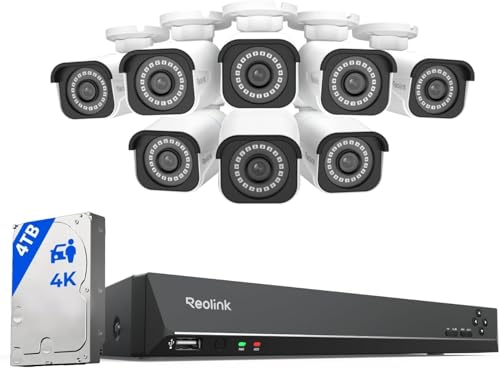
REOLINK 16CH 4K Security Bullet Camera System with 4TB HDD RLK16-800B8
$1,259.99Sixteen channels with eight 4K bullets and a 4TB drive, so there are eight spare channels for later without replacing the recorder.
- Channels
- 16
- Cameras included
- 8
- Resolution
- 8 MP
- Drive included
- 4 TB
Prices change often.

ANNKE 8CH 4K PoE Security Camera System, Smart Dual Light, 2TB HDD
$499.99Dual light means the camera holds colour at night using a white light lamp instead of falling back to infrared monochrome, which matters because clothing colour is often the only usable detail.
- Channels
- 8
- Resolution
- 8 MP
- Drive included
- 2 TB
- Storage
- Local NVR
Prices change often.

Lorex V-Series 8Ch 4K NVR System with 4 Bullet Cameras
$879.99Lorex runs its own app and does local processing on the recorder, and publishes a clear position on where footage is held, which is the question worth asking before a camera watches a front door.
- Channels
- 8
- Cameras included
- 4
- Resolution
- 8 MP
- Storage
- Local NVR
Prices change often.

Swann AdvancedX Wired NVR 4K Security Camera System, 8 Channels, 8 PoE Cameras
$749.99All eight channels populated at once, which is the cheapest cost per camera in this catalog for a fully loaded eight channel recorder.
- Channels
- 8
- Cameras included
- 8
- Resolution
- 8 MP
- Storage
- Local NVR
Prices change often.

REOLINK 8CH 5MP PoE Security Camera System with 2TB HDD RLK8-410B4-5MP
$459.98Four 5MP cameras and a drive on an eight channel recorder, which covers the four sides of a typical house and leaves four channels free for the cameras you discover you need.
- Channels
- 8
- Cameras included
- 4
- Resolution
- 5 MP
- Drive included
- 2 TB
Prices change often.

ANNKE 8CH 5MP PoE Security Camera System, 2TB HDD, Red and Blue Light Alarm
$319.99The cheapest route in this catalog to a real local recorder with a drive, rather than to cameras that depend on a subscription to keep anything.
- Channels
- 8
- Resolution
- 5 MP
- Drive included
- 2 TB
- Storage
- Local NVR
Prices change often.
Common questions
What is a PoE security camera system?
A PoE, or Power over Ethernet, security camera system uses a single Ethernet cable to carry both electrical power and video data between each camera and a recorder. The recorder stores footage locally on an internal hard drive, so there is no cloud subscription required, provided the cable run stays within the 100 meter Ethernet channel limit.
How many cameras do I need for a typical house?
Most three or four bedroom houses need between four and eight camera positions covering the front door, back door, driveway and any side gate or blind corner. Run your actual entry points through a camera count calculator rather than guessing, since a corner lot or a detached garage can add two or three positions that a generic room count would miss.
Do PoE systems require a monthly fee?
No. A PoE system with a local NVR and a hard drive records and stores footage on your own property, and none of the systems in this roundup require a subscription to keep or review that footage. Remote viewing through the manufacturer app is free on every system listed here, though some brands sell optional cloud backup as an add-on.
What happens if a channel does not have a camera plugged in?
Nothing. An empty channel on an 8 or 16 channel NVR simply sits unused until you add a camera, and it does not affect the recording of the channels that are populated. This is why buying a recorder with a few spare channels is a reasonable way to plan for a camera you will add later, rather than wasted expense.
Can I mix camera brands on one PoE system?
The complete kits in this roundup are built and sold to work with the matching brand cameras, and most will not fully support a different brand. If mixing brands matters to you, a standalone NVR built to open standards, rather than a bundled kit, is the better starting point, since it is designed to accept compliant PoE cameras from more than one maker.
Get the system planning sheet
The camera count, storage and PoE budget worksheet, plus the wiring checklist, as one printable page.
Keep going
Before you point a camera at anything. Aim cameras at your own property and your own boundary, never into a neighbour's windows or across their garden. Cameras in bedrooms, bathrooms, or anywhere else a person reasonably expects privacy are a serious legal problem, and that includes guests, lodgers and anyone who works in your home. Audio is legally different from video, many US states require the consent of every party to a recorded conversation, and several recorders capture audio by default, so check your own state before you enable it. Some places require visible notice that recording is taking place, and landlords and homeowner associations often impose their own rules on top. This is researched general information and not legal advice, and the law varies by state and by country.
And once it is installed. Change every default password, keep the firmware updated, and be clear with yourself about where the footage goes: a cloud camera means a third party holds recordings of your home, while a local recorder keeps them in your house. That is a genuine buying consideration, not a technicality.