Lorex V-Series 4K NVR System Review
The Lorex V-Series 8 channel 4K system ships four 8MP bullet cameras and a 1TB drive, expandable to 10TB, for $879.99. Computed from the published camera count, resolution and drive size, that 1TB drive holds about 3.6 days of continuous 24/7 recording, and the same formula shows that upgrading to a 4TB drive would stretch that to roughly 14.4 days.
The Lorex V-Series system is one of the more precisely specified kits in this catalog: it states an exact camera count, four, on an 8 channel recorder, and its own feature text states a specific pre-installed drive size, 1TB, expandable to 10TB. That precision makes it a good candidate for a full storage calculation rather than the partial one some other listings allow.
This review is built from those published figures and the standard storage math this site uses throughout, and it flags where Lorex own compatibility position is less clear than a REOLINK or ANNKE listing.
| Spec | Value |
|---|---|
| Recorder channels | 8 |
| Cameras included | 4 |
| Camera resolution | 8MP (3840x2160) |
| Pre-installed drive | 1TB, expandable to 10TB (published) |
| Design | Fanless with built-in heatsink (published) |
| Monthly fees | None for local storage (published) |
| Price | $879.99 |
What ships in the box, and what does not
The system includes an 8 channel NVR, four 8MP bullet cameras, and a 1TB drive already installed, described by Lorex as expandable up to 10TB. That leaves four channels open on the recorder, which suits a four-sided house with room to add a driveway or garage camera later.
This specific listing does not state whether the recorder accepts third-party PoE cameras on those four spare channels. The safe assumption for filling them is genuine Lorex-compatible hardware rather than a mixed-brand camera, since the listing gives no indication either way.
The real storage math on the included 1TB drive
At the typical 6 Mbps H.265 convention for an 8MP stream, four cameras write about 4 times 2,700 MB per hour, times 24 hours, or 259,200 MB per day. Applying the standard 93 percent usable fraction, a 1TB drive holds about 930,000 MB of usable space, which divides out to about 3.6 days of continuous 24/7 recording across all four cameras.
Lorex own feature text states the drive is expandable up to 10TB. Running the same four-camera math against a 4TB drive instead of the included 1TB, a size increase Lorex explicitly supports, computes to about 14.4 days, which lands almost exactly on the 14-day minimum retention convention most insurers and buyers use as a starting target. Anyone planning to keep this system past a long weekend away should budget for that upgrade from day one.
What Lorex publishes about its own platform
Lorex feature text states that recording and access are local, with no monthly fees required for the included storage and Smart Search features that filter recordings by motion type and other attributes. It also states the recorder uses a fanless design with a heatsink for quiet, continuous operation, which matters for a box likely to sit in a living space rather than a closet.
The listing does not publish a focal length for the included cameras, so, as with the other bundled kits in this catalog, an exact DORI identify distance cannot be computed for this specific system.
Price per camera against an eight-camera kit
At $879.99 for four cameras, this kit works out to about $220 per camera, noticeably higher than the roughly $126 per camera the REOLINK RLK8-800B6 works out to at six cameras, or the roughly $157 per camera the RLK16-800B8 works out to at eight. Some of that gap is brand and platform, and some of it is simply that a four-camera kit spreads the fixed cost of the recorder and drive across fewer units than an eight-camera kit does.
That math favors this system for a buyer who specifically wants four cameras and the Lorex platform, and favors a REOLINK kit for a buyer chasing the lowest price per camera at a similar resolution. Neither is a wrong choice; they are simply optimizing for different things.
Is this a hands-on review
No. This is not a hands-on review. This system has not been installed or run by anyone on this team, and no claim above rests on a mounted unit. Every figure is either quoted from the Lorex listing or computed from it using the standard storage formula this site documents.
Who should not buy this
Anyone who needs all eight channels filled with cameras out of the box should look elsewhere, since only four cameras are included here and cross-brand compatibility for the remaining four channels is not stated.
Anyone planning to record continuously on all four cameras for more than a few days should budget immediately for a larger drive; the included 1TB is genuinely short at about 3.6 days.
Anyone who needs a stated lens focal length or DORI distance before buying will not find one published for this system.
The gear that matches this answer

Lorex V-Series 8Ch 4K NVR System with 4 Bullet Cameras
$879.99Lorex runs its own app and does local processing on the recorder, and publishes a clear position on where footage is held, which is the question worth asking before a camera watches a front door.
- Channels
- 8
- Cameras included
- 4
- Resolution
- 8 MP
- Storage
- Local NVR
Prices change often.

Lorex U-Series 8Ch 4K NVR System with 5 Bullet Cameras
$799.99Five cameras on an eight channel recorder, which is the awkward and very common house: four walls plus a detached garage.
- Channels
- 8
- Cameras included
- 5
- Resolution
- 8 MP
- Storage
- Local NVR
Prices change often.

REOLINK 8CH 4K Security Camera System with 2TB HDD RLK8-800B6
$755.99Six 4K bullet cameras on an eight channel PoE recorder with a 2TB drive already fitted, which is the configuration most three bedroom homes land on after doing the entry point count.
- Channels
- 8
- Cameras included
- 6
- Resolution
- 8 MP
- Drive included
- 2 TB
Prices change often.
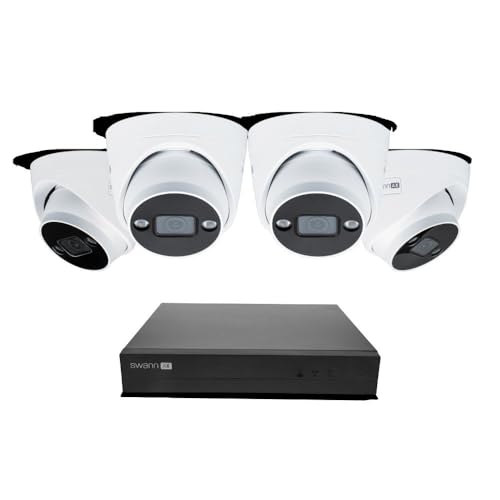
Swann AdvancedX Wired NVR 4K Security Camera System, 8 Channels, 4 PoE Dome Cameras
$487.59Four 4K domes and an eight channel recorder, and Swann publishes full local access so the system keeps working if the company ever stops running an app.
- Channels
- 8
- Cameras included
- 4
- Resolution
- 8 MP
- Storage
- Local NVR
Prices change often.

ANNKE 8CH 4K PoE Security Camera System, Smart Dual Light, 2TB HDD
$499.99Dual light means the camera holds colour at night using a white light lamp instead of falling back to infrared monochrome, which matters because clothing colour is often the only usable detail.
- Channels
- 8
- Resolution
- 8 MP
- Drive included
- 2 TB
- Storage
- Local NVR
Prices change often.
Common questions
How long does the included 1TB drive actually last?
Computed from the published four cameras at 8MP resolution and the typical 6 Mbps H.265 bitrate convention, the 1TB drive usable capacity holds about 3.6 days of continuous 24/7 recording. Motion-only recording extends that figure, though no exact duty cycle is published to size the extension.
Can I upgrade the drive in this system?
Yes. Lorex own feature text states the storage is expandable up to 10TB. Upgrading from the included 1TB to a 4TB drive, using the same four cameras, computes to about 14.4 days of continuous recording, close to the common 14-day minimum retention target.
Are there monthly fees for using this system?
No. Lorex states that local recording and access through the included storage require no monthly subscription. Optional cloud features, if Lorex offers them for this model, are a separate purchase and not required for basic local recording and playback.
Can I add non-Lorex cameras to the four spare channels?
This listing does not state whether the recorder accepts third-party PoE cameras. Without that confirmation published, the safer assumption is to fill the remaining channels with Lorex-compatible cameras rather than assuming open compatibility.
What is the identify distance for these cameras?
This listing does not publish a lens focal length for the included cameras, which is required to compute a DORI identify distance. No honest distance figure can be stated without that published spec.
Get the system planning sheet
The camera count, storage and PoE budget worksheet, plus the wiring checklist, as one printable page.
Keep going
Before you point a camera at anything. Aim cameras at your own property and your own boundary, never into a neighbour's windows or across their garden. Cameras in bedrooms, bathrooms, or anywhere else a person reasonably expects privacy are a serious legal problem, and that includes guests, lodgers and anyone who works in your home. Audio is legally different from video, many US states require the consent of every party to a recorded conversation, and several recorders capture audio by default, so check your own state before you enable it. Some places require visible notice that recording is taking place, and landlords and homeowner associations often impose their own rules on top. This is researched general information and not legal advice, and the law varies by state and by country.
And once it is installed. Change every default password, keep the firmware updated, and be clear with yourself about where the footage goes: a cloud camera means a third party holds recordings of your home, while a local recorder keeps them in your house. That is a genuine buying consideration, not a technicality.