REOLINK RLK16-800B8 Review
The REOLINK RLK16-800B8 pairs eight 4K (8MP) bullet cameras with a 16 channel NVR and a 4TB drive for $1,259.99. Computed from the published resolution and the typical H.265 bitrate convention, that drive holds about 7.2 days of continuous 24/7 recording across all eight cameras, with eight recorder channels left for future growth.
The RLK16-800B8 is the larger sibling of the RLK8-800B6, built for a property that either has more than eight entry points today or expects to add cameras later. A 16 channel recorder with eight cameras installed is a specific bet: half the channels are already earning their keep, and the other half are pure headroom.
This review treats the listing the same way every review on this site does: every figure is either quoted from the published specification and feature text or computed from it using the standard DORI, storage and Ethernet formulas, and anywhere REOLINK does not publish a number, that gap is stated rather than filled in.
| Spec | Value |
|---|---|
| Recorder channels | 16 |
| Cameras included | 8 |
| Camera resolution | 8MP (3840x2160) |
| Pre-installed drive | 4TB |
| PoE cable run | Up to 330 ft per camera (published) |
| IR range | Not published for this listing |
| Price | $1,259.99 |
What sixteen channels actually buys over eight
The recorder ships with eight bullet cameras connected and eight channels open. That headroom is the entire reason to choose this kit over the RLK8-800B6: a detached garage, a second driveway camera, or a gate added a year later can be plugged straight into a spare channel rather than forcing a recorder swap.
REOLINK publishes a PoE cable run of up to 330 feet for this kit. That figure sits essentially at the 100 meter (about 328 foot) ANSI/TIA-568 Ethernet channel limit, so the extra two feet in the marketing figure reads as a rounding of the metric conversion rather than a genuine claim of exceeding the standard.
The storage math on the 4TB drive
At the typical 6 Mbps H.265 convention for an 8MP stream, one camera writes about 2,700 MB per hour. Across eight cameras recording continuously, that is 8 times 2,700 times 24, or 518,400 MB per day.
A 4TB drive holds about 3,720,000 MB of usable capacity once the standard 93 percent usable fraction is applied. Divided by the daily write, that is about 7.2 days of continuous 24/7 recording across all eight cameras. Motion-only recording extends this figure, though REOLINK does not publish a typical duty cycle to size the extension precisely, and a scene with a lot of night motion will write closer to the top of the typical bitrate range than the bottom.
What is not published for this listing
This listing does not state a focal length, an IR range in feet, or a low-light lux figure for the bundled cameras. Where the RLK8-800B6 listing does publish an IR distance for its cameras, this listing does not carry the same figure, and treating the two kits as identical on that point would be an assumption this review is not willing to make.
Anyone who wants an exact DORI identify distance for these cameras should pull the focal length from the printed manufacturer datasheet and run it through the DORI distance calculator, since a computed distance built on a guessed focal length is worse than no distance at all.
Price per camera against the RLK8-800B6
At $1,259.99 for eight cameras, this kit works out to about $157 per camera including the recorder and the drive. The RLK8-800B6 at $755.99 for six cameras works out to about $126 per camera, a meaningfully lower figure. The difference is the price of the eight spare channels and the larger 4TB drive, not the cameras themselves, so a buyer who genuinely needs sixteen channels should expect to pay a premium over a same-brand eight channel kit rather than assuming a larger box scales down in per-camera cost.
That premium is easiest to justify when the spare channels have a concrete plan behind them, a garage, a gate, a second building, rather than sitting empty as generic headroom. Empty channels do not depreciate, but they also do not pay for themselves.
Is this a hands-on review
No. This is not a hands-on review. This system has not been installed or run on a property by anyone on this team. The figures above come from the published listing and from the standard formulas this site documents, not from a mounted camera watched over time.
Who should not buy this
A four to six entry point house does not need sixteen channels, and the eight empty channels here are a cost with no return until they are filled. The RLK8-800B6, at six cameras on eight channels, is the better fit for that property size.
Anyone who has already decided on dome bodies for eave mounting should look at the RLK16-800D8 instead, which uses the identical recorder and drive specification in a dome housing that is harder to knock out of alignment.
A long single approach that needs to resolve a face at range, rather than eight separate detect-only positions, is better served by fewer cameras with real optical zoom, such as the RLC-823S1 PTZ, than by more fixed 4K bullets.
The gear that matches this answer
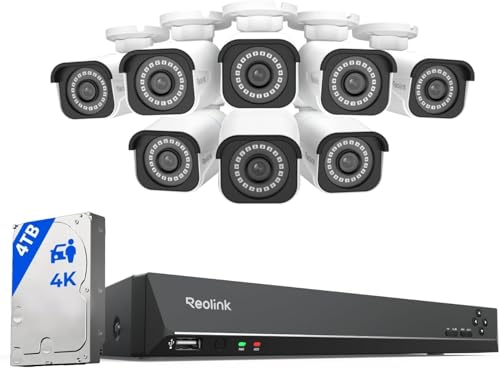
REOLINK 16CH 4K Security Bullet Camera System with 4TB HDD RLK16-800B8
$1,259.99Sixteen channels with eight 4K bullets and a 4TB drive, so there are eight spare channels for later without replacing the recorder.
- Channels
- 16
- Cameras included
- 8
- Resolution
- 8 MP
- Drive included
- 4 TB
Prices change often.

REOLINK 8CH 4K Security Camera System with 2TB HDD RLK8-800B6
$755.99Six 4K bullet cameras on an eight channel PoE recorder with a 2TB drive already fitted, which is the configuration most three bedroom homes land on after doing the entry point count.
- Channels
- 8
- Cameras included
- 6
- Resolution
- 8 MP
- Drive included
- 2 TB
Prices change often.

REOLINK 16CH 4K Security Dome Camera System with 4TB HDD RLK16-800D8
$1,259.99The dome bodied version of the same sixteen channel system, which is harder to knock out of alignment and reads as less aggressive on a residential street.
- Channels
- 16
- Cameras included
- 8
- Resolution
- 8 MP
- Drive included
- 4 TB
Prices change often.

ANNKE 16 Channel Security Camera System 4K PoE, Smart Dual Light, 4TB HDD
$849.99Sixteen channels of 4K with a 4TB drive, priced below the equivalent sixteen channel systems from the larger brands.
- Channels
- 16
- Resolution
- 8 MP
- Drive included
- 4 TB
- Storage
- Local NVR
Prices change often.
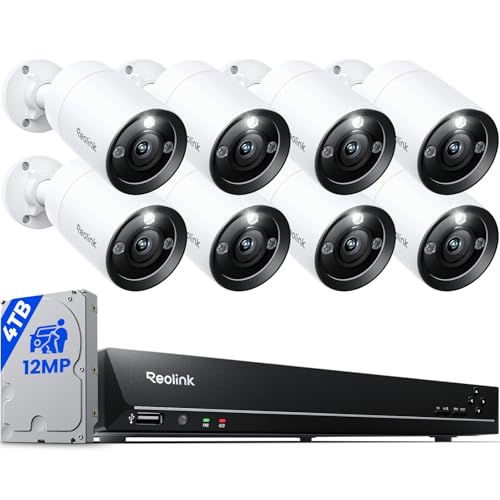
REOLINK 16CH 12MP Security Bullet Camera System with 4TB HDD RLK16-1200B8-A
$1,499.99Twelve megapixel sensors put roughly 4,512 horizontal pixels across the scene instead of 3,840, which is the difference between recognising and identifying someone at the end of a long drive.
- Channels
- 16
- Cameras included
- 8
- Resolution
- 12 MP
- Drive included
- 4 TB
Prices change often.
Common questions
How long does the 4TB drive record before it overwrites itself?
Computed from the published 8MP resolution at the typical 6 Mbps H.265 convention across all eight cameras, the usable capacity of a 4TB drive holds about 7.2 days of continuous 24/7 recording. Motion-only recording extends this, though no exact figure is published for how much.
What is the night vision range of the RLK16-800B8 cameras?
This specific listing does not publish an infrared range in feet or a lux rating for the bundled cameras. Where some REOLINK kits state a 100 foot IR figure in their feature text, this one does not carry that claim, so it should not be assumed to match.
Should I buy this over the RLK8-800B6 for a normal house?
Only if the property genuinely has more than six to eight entry points, or an expansion is already planned. For a typical four to six entry point house, the RLK8-800B6 covers the same ground with less unused capacity.
Can this recorder mix bullet and dome cameras?
The recorder itself is body-agnostic and accepts any compatible REOLINK PoE camera on its open channels, including the dome-bodied RLK16-800D8 cameras or a standalone camera like the RLC-820A dome, so mixing bullet and dome bodies on the same recorder is possible.
What cable run does REOLINK publish for this kit?
REOLINK states a PoE cable run of up to 330 feet, which sits essentially at the 100 meter (about 328 foot) ANSI/TIA-568 Ethernet channel limit most structured cabling is built to. Runs approaching that figure should be checked with the cable run limit calculator before committing to a cable path.
Get the system planning sheet
The camera count, storage and PoE budget worksheet, plus the wiring checklist, as one printable page.
Keep going
Before you point a camera at anything. Aim cameras at your own property and your own boundary, never into a neighbour's windows or across their garden. Cameras in bedrooms, bathrooms, or anywhere else a person reasonably expects privacy are a serious legal problem, and that includes guests, lodgers and anyone who works in your home. Audio is legally different from video, many US states require the consent of every party to a recorded conversation, and several recorders capture audio by default, so check your own state before you enable it. Some places require visible notice that recording is taking place, and landlords and homeowner associations often impose their own rules on top. This is researched general information and not legal advice, and the law varies by state and by country.
And once it is installed. Change every default password, keep the firmware updated, and be clear with yourself about where the footage goes: a cloud camera means a third party holds recordings of your home, while a local recorder keeps them in your house. That is a genuine buying consideration, not a technicality.