Best 4K Security Camera Systems
For a full property in true 4K, the REOLINK RLK16-800B8 pairs eight 8MP cameras with a 4TB drive on a 16 channel recorder for $1,259.99, the largest complete 4K kit in this roundup.
In this catalog, 4K resolution means an 8 megapixel sensor recording at 3840 by 2160 pixels, which is the resolution every complete system in this roundup uses. That is roughly four times the pixel count of a 1080p camera, and it is the point at which digital zoom on playback starts to reveal usable detail instead of a smear of blocks.
More pixels only help if the drive can hold them. An 8MP stream is a larger file than a 1080p stream at the same frame rate, so a 4K system with a small drive fills up and starts overwriting old footage sooner than the camera count would suggest. Check your own numbers with the NVR storage days calculator before assuming a bundled drive is big enough.
The systems below were researched from published manufacturer specifications and verified owner reviews, compared on channel count, included camera count, drive size and price per camera.
| System | Channels | Cameras | Drive | Price |
|---|---|---|---|---|
| REOLINK RLK16-800B8 | 16 | 8 | 4TB | $1,259.99 |
| REOLINK RLK16-800D8 (dome) | 16 | 8 | 4TB | $1,259.99 |
| REOLINK RLK8-800B6 | 8 | 6 | 2TB | $755.99 |
| ANNKE 16 Channel 4K | 16 | not listed | 4TB | $849.99 |
| ANNKE 8CH 4K | 8 | not listed | 2TB | $499.99 |
| Lorex V-Series 8Ch | 8 | 4 | not listed | $879.99 |
| Swann AdvancedX 8CH, 8 camera | 8 | 8 | not listed | $749.99 |
Is 4K worth it over 5MP or 1080p
The jump from 1080p to 4K roughly quadruples the pixels covering the same scene, which mostly shows up as more usable digital zoom on playback rather than a visibly sharper live view on a small phone screen. The jump from 5MP to 4K is smaller and easier to skip if the price difference is large.
Where 4K earns its price is a wide scene, such as a driveway or a yard, where you need to zoom into one corner of the frame after the fact. A narrow scene, such as a single door, gets less benefit from the extra pixels since there is less frame to crop into.
Beginner picks
A first 4K system should not require guessing at compatible cameras or a separate drive purchase.
The ANNKE 8CH 4K kit bundles a 2TB drive with its cameras at $499.99, the lowest price in this roundup for a complete 4K kit with a drive already fitted, and its dual light feature holds color at night using a built-in white light rather than falling back to infrared only.
Intermediate picks
Once coverage count is settled, the next step up is usually more cameras on the same channel count, or a body style that suits the mounting points on the house.
The REOLINK RLK8-800B6 puts six 4K cameras and a 2TB drive on an 8 channel recorder, which is the configuration most three or four bedroom homes land on after counting entry points.
Expert picks
A large property, or a build that will keep adding cameras, needs channel headroom and drive size that will not need replacing in a year.
The REOLINK RLK16-800B8 and its dome bodied version RLK16-800D8 both put eight 4K cameras and a 4TB drive on a 16 channel recorder. The ANNKE 16 Channel kit reaches the same channel and resolution count at a lower price, at $849.99 against roughly $1,259.99 for the REOLINK equivalents.
How we chose
This comparison was built from published manufacturer specifications and verified owner reviews on retail listings. We did not purchase, mount or run any of these systems ourselves, and this is not a hands-on test of image quality or drive reliability.
We did check that each listed channel count, camera count and drive size matched between the product title and the specification bullet points, and we flagged systems where the included camera count was not stated so the buyer knows to check before ordering.
The 4K systems we compared
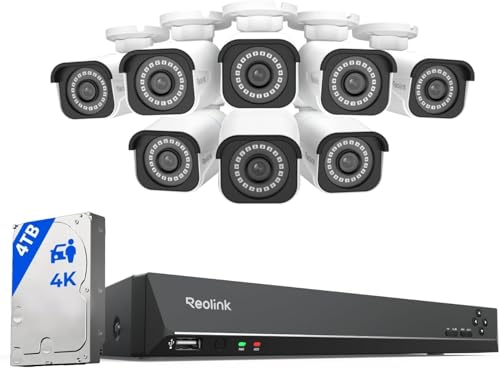
REOLINK 16CH 4K Security Bullet Camera System with 4TB HDD RLK16-800B8
$1,259.99Sixteen channels with eight 4K bullets and a 4TB drive, so there are eight spare channels for later without replacing the recorder.
- Channels
- 16
- Cameras included
- 8
- Resolution
- 8 MP
- Drive included
- 4 TB
Prices change often.

REOLINK 8CH 4K Security Camera System with 2TB HDD RLK8-800B6
$755.99Six 4K bullet cameras on an eight channel PoE recorder with a 2TB drive already fitted, which is the configuration most three bedroom homes land on after doing the entry point count.
- Channels
- 8
- Cameras included
- 6
- Resolution
- 8 MP
- Drive included
- 2 TB
Prices change often.

REOLINK 16CH 4K Security Dome Camera System with 4TB HDD RLK16-800D8
$1,259.99The dome bodied version of the same sixteen channel system, which is harder to knock out of alignment and reads as less aggressive on a residential street.
- Channels
- 16
- Cameras included
- 8
- Resolution
- 8 MP
- Drive included
- 4 TB
Prices change often.

ANNKE 8CH 4K PoE Security Camera System, Smart Dual Light, 2TB HDD
$499.99Dual light means the camera holds colour at night using a white light lamp instead of falling back to infrared monochrome, which matters because clothing colour is often the only usable detail.
- Channels
- 8
- Resolution
- 8 MP
- Drive included
- 2 TB
- Storage
- Local NVR
Prices change often.

ANNKE 16 Channel Security Camera System 4K PoE, Smart Dual Light, 4TB HDD
$849.99Sixteen channels of 4K with a 4TB drive, priced below the equivalent sixteen channel systems from the larger brands.
- Channels
- 16
- Resolution
- 8 MP
- Drive included
- 4 TB
- Storage
- Local NVR
Prices change often.

Lorex V-Series 8Ch 4K NVR System with 4 Bullet Cameras
$879.99Lorex runs its own app and does local processing on the recorder, and publishes a clear position on where footage is held, which is the question worth asking before a camera watches a front door.
- Channels
- 8
- Cameras included
- 4
- Resolution
- 8 MP
- Storage
- Local NVR
Prices change often.

Swann AdvancedX Wired NVR 4K Security Camera System, 8 Channels, 8 PoE Cameras
$749.99All eight channels populated at once, which is the cheapest cost per camera in this catalog for a fully loaded eight channel recorder.
- Channels
- 8
- Cameras included
- 8
- Resolution
- 8 MP
- Storage
- Local NVR
Prices change often.
Common questions
What resolution counts as 4K in a security camera?
In this catalog, 4K refers to an 8 megapixel sensor recording at 3840 by 2160 pixels, sometimes labeled Ultra HD. That is the standard 4K resolution used by every complete system in this roundup, and it is roughly four times the total pixel count of a 1080p camera at the same field of view.
Does 4K use more storage than lower resolutions?
Yes. A 4K stream carries more data per frame than a 1080p or 5MP stream at the same frame rate and compression setting, so a drive fills faster at 4K than it would recording the same number of cameras at a lower resolution. Run your camera count and resolution through a storage days calculator before assuming a bundled drive size is enough.
Is a bigger drive always better in a 4K system?
A bigger drive buys more days of retained footage before the oldest recordings get overwritten, which matters if an incident is not discovered right away. It does not improve image quality. Match drive size to how many days of footage you actually want on hand at your camera count and resolution, rather than buying the largest drive available.
Can I add more cameras to an 8 channel 4K system later?
Only up to the number of channels the recorder has. An 8 channel recorder with all 8 channels already populated has no room for another wired camera without replacing the recorder, while a system sold with fewer cameras than channels, such as a 4 camera kit on an 8 channel recorder, has room to add more later.
Do dome and bullet versions of the same 4K system perform differently?
The REOLINK RLK16-800B8 and RLK16-800D8 use the same sensor, channel count and drive size, and differ mainly in body style. A dome hides its aim direction and resists being knocked out of alignment better than a bullet, which matters more on a soffit or eave mount than it does on a wall where the camera is easy to re-aim.
Get the system planning sheet
The camera count, storage and PoE budget worksheet, plus the wiring checklist, as one printable page.
Keep going
Before you point a camera at anything. Aim cameras at your own property and your own boundary, never into a neighbour's windows or across their garden. Cameras in bedrooms, bathrooms, or anywhere else a person reasonably expects privacy are a serious legal problem, and that includes guests, lodgers and anyone who works in your home. Audio is legally different from video, many US states require the consent of every party to a recorded conversation, and several recorders capture audio by default, so check your own state before you enable it. Some places require visible notice that recording is taking place, and landlords and homeowner associations often impose their own rules on top. This is researched general information and not legal advice, and the law varies by state and by country.
And once it is installed. Change every default password, keep the firmware updated, and be clear with yourself about where the footage goes: a cloud camera means a third party holds recordings of your home, while a local recorder keeps them in your house. That is a genuine buying consideration, not a technicality.