Best Home Security Cameras
The REOLINK RLC-810A is the best standalone home security camera for most driveways and entry points, delivering 4K resolution with on-camera person and vehicle detection for $84.99.
Every camera in this roundup is a PoE camera, meaning it needs a network video recorder or a PoE switch and injector to power it and to record its video. None of these are standalone WiFi cameras that record to the cloud on their own, and that tradeoff is the whole point: a wired PoE camera keeps working during a WiFi outage and its footage is not held by a third party.
The cameras below were researched from published manufacturer specifications and verified owner reviews, then compared on resolution, field of view, infrared or color night vision range and price, since a marketing photo tells you nothing about how far a camera can actually resolve a face after dark.
If you are adding a camera to an existing recorder, check open channels first. If you are starting from zero, look at the best PoE security camera system roundup instead, since a bundled kit is usually cheaper per camera than buying a recorder and cameras separately.
| Camera | Resolution | Field of view | Night vision range | Price |
|---|---|---|---|---|
| REOLINK RLC-810A | 8MP (4K) | not listed | not listed | $84.99 |
| REOLINK RLC-820A | 8MP (4K) | not listed | not listed | $99.99 |
| Amcrest 4K AI Bullet | 8MP (4K) | 129 degrees | 49 ft, color | $109.99 |
| Amcrest 5MP AI Bullet | 5MP | not listed | 49 ft, color | $74.99 |
| Amcrest 4K Turret | 8MP (4K) | not listed | 98 ft, infrared | $88.99 |
| REOLINK RLC-1212A | 12MP | not listed | not listed | $129.99 |
| Amcrest 5MP Budget Bullet | 5MP | 103 degrees | not listed | $48.99 |
Bullet, dome or turret: which body style
A bullet camera points visibly in one direction and its shape is itself a deterrent, since anyone can see it is aimed at them. A dome or turret hides the aim direction and is markedly harder to knock out of alignment from a ladder, which matters on an eave or soffit mount you do not want to keep climbing back up to.
Turret cameras split the difference: they aim like a bullet but sit inside a small dome housing, which avoids the infrared bounce a true flat dome can get off its own cover glass in the dark.
Beginner picks
A first standalone camera should have its specifications published in full, not just a marketing description, so you can check it will actually cover the spot you have in mind before you buy it.
The Amcrest 5MP Outdoor PoE Camera is the cheapest camera in this catalog from a maker that still ships firmware updates, and it publishes both its pixel dimensions and its 103 degree viewing angle, so coverage is computable rather than guessed at. The REOLINK RLC-810A costs more but adds on-camera person and vehicle detection, which cuts down false alerts.
Intermediate picks
Most households settle on a 4K PoE bullet or dome with AI based person and vehicle filtering once the first camera proves the concept.
The Amcrest UltraHD 4K AI Camera adds a 129 degree field of view, which covers a whole driveway from a single mount, at the cost of pixel density at range. The REOLINK RLC-820A is the dome bodied equivalent of the RLC-810A for a soffit mount where you do not want the aim direction visible.
Expert picks
Where one camera has to identify a face or a plate at the far end of a long approach rather than just detect that something moved, resolution and lens choice matter more than any other spec.
The REOLINK RLC-1212A puts 12 megapixels, or roughly 4,512 horizontal pixels, across the scene instead of the 3,840 pixels a typical 4K sensor delivers, which is the difference between recognizing a shape and identifying a person at the end of a long drive.
How we chose
This roundup came from published manufacturer specifications and verified owner reviews on retail listings, not from cameras mounted and run on a test property. We did not install or field test any of these cameras, and nothing here should be read as a hands-on comparison.
We did check that each listed resolution, field of view and infrared or color night vision range appeared consistently across the product title, the bullet points and the manufacturer page, and we noted where a spec, such as viewing angle, was missing from the listing entirely.
The cameras we compared

REOLINK RLC-810A PoE Security Camera, 4K Wired Outdoor
$84.99The default 4K PoE bullet in this catalog: person and vehicle detection on the camera itself, so alerts are not triggered by every passing shadow.
- Resolution
- 8 MP
- Lens
- 4 mm
- Storage
- PoE, needs an NVR or NAS
Prices change often.
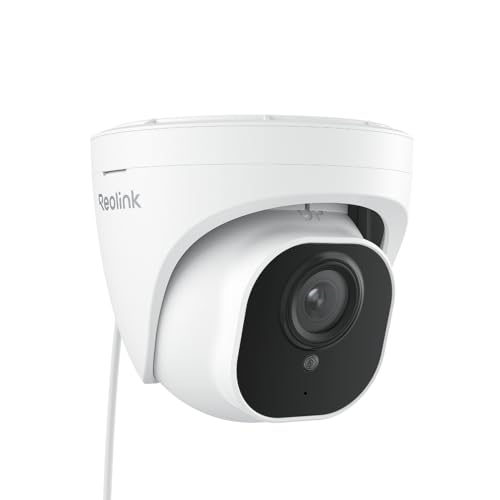
REOLINK RLC-820A 4K PoE Security Camera, Wired Outdoor Dome
$99.99The dome counterpart to the RLC-810A, same sensor and same detection, in a body that does not advertise which way it is looking.
- Resolution
- 8 MP
Prices change often.

Amcrest UltraHD 4K 8MP IP PoE AI Camera, 129 degree FOV, 49ft Color Nightvision
$109.99A 129 degree field of view covers a whole driveway from one mount, at the cost of pixel density: the wider the lens, the shorter the distance at which it can still identify anyone.
- Resolution
- 8 MP
- Field of view
- 129 degrees
- Stated IR range
- 49 ft
Prices change often.

Amcrest 5MP IP PoE AI Camera with 49ft Color Night Vision, Outdoor Bullet
$74.99Colour night vision rather than infrared monochrome, which preserves clothing and vehicle colour, the two details a police report actually asks for.
- Resolution
- 5 MP
- Stated IR range
- 49 ft
Prices change often.

Amcrest UltraHD 4K 8MP Outdoor Security IP Turret PoE Camera, 98ft NightVision
$88.99A turret aims like a bullet but sits in a dome housing, so it avoids the infrared bounce a true dome can get off its own cover glass.
- Resolution
- 8 MP
- Stated IR range
- 98 ft
Prices change often.

REOLINK RLC-1212A 12MP Bullet Outdoor PoE Camera
$129.99Twelve megapixels on a single camera, which buys real DORI identify distance on the one approach where you actually need a face rather than a shape.
- Resolution
- 12 MP
Prices change often.
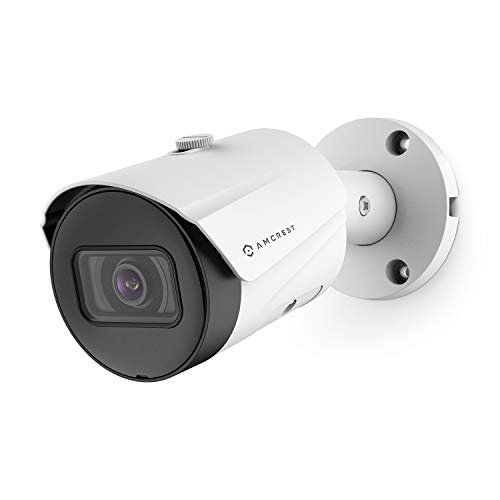
Amcrest 5MP Outdoor PoE Camera 2592x1944p Bullet IP Security Camera, 103 degree Viewing Angle
$48.99The cheapest camera in this catalog from a maker that still ships firmware, and it publishes both its pixel dimensions and its viewing angle so coverage is computable.
- Resolution
- 5 MP
- Field of view
- 103 degrees
Prices change often.
Common questions
Do PoE security cameras need WiFi?
No. A PoE camera gets both power and its network connection through a single Ethernet cable, so it keeps recording during a WiFi outage as long as the recorder and the switch stay powered. This is one of the main reasons PoE cameras remain the standard choice for a fixed entry point camera rather than a battery or WiFi camera.
How far can these cameras see at night?
Infrared night vision range in this catalog runs from about 49 feet on a color night vision camera up to 100 feet on a standard infrared model, though color night vision usually has a shorter effective range than black and white infrared. Check the specific listed range for each camera rather than assuming a higher resolution camera automatically sees farther in the dark.
What is the difference between a bullet, dome and turret camera?
A bullet camera has a visible cylindrical body that points where you aim it, which acts as its own visible deterrent. A dome camera hides its aim direction inside a rounded housing and is harder to knock out of alignment. A turret camera aims like a bullet but sits in a small dome shaped housing, avoiding the infrared glare a flat dome cover can produce at night.
Can I add one of these cameras to an NVR I already own?
Only if the NVR is built to accept that camera brand, or if both the camera and the recorder follow the same open PoE camera standard. REOLINK and Amcrest cameras generally pair with recorders from the same brand, while a standards based recorder, such as the TRENDnet TV-NVR1508, is built to accept compliant cameras from more than one maker.
Is a higher resolution camera always the better choice?
Not automatically. Resolution sets how many pixels cover a given distance, which matters for identifying a face or a plate at range, but a wider field of view spreads the same pixel count over more ground, lowering pixel density at any one point. A narrower lens with fewer total pixels can still resolve a face farther away than a wide lens with more pixels.
Get the system planning sheet
The camera count, storage and PoE budget worksheet, plus the wiring checklist, as one printable page.
Keep going
Before you point a camera at anything. Aim cameras at your own property and your own boundary, never into a neighbour's windows or across their garden. Cameras in bedrooms, bathrooms, or anywhere else a person reasonably expects privacy are a serious legal problem, and that includes guests, lodgers and anyone who works in your home. Audio is legally different from video, many US states require the consent of every party to a recorded conversation, and several recorders capture audio by default, so check your own state before you enable it. Some places require visible notice that recording is taking place, and landlords and homeowner associations often impose their own rules on top. This is researched general information and not legal advice, and the law varies by state and by country.
And once it is installed. Change every default password, keep the firmware updated, and be clear with yourself about where the footage goes: a cloud camera means a third party holds recordings of your home, while a local recorder keeps them in your house. That is a genuine buying consideration, not a technicality.