Bullet vs Dome Security Cameras
Choose a bullet for most homes: it is cheaper, easier to aim precisely, and its obvious shape does real deterrent work by itself. Choose a dome or turret only when the mount is within arm's reach of the ground, where a dome's housing resists being knocked out of alignment or grabbed far better than an exposed bullet.
The image quality argument between bullet and dome cameras is mostly a non-argument. Camera makers routinely ship the same sensor, the same lens options and the same detection features in both body styles, so the choice is really about the physical shape and what that shape does or does not protect against.
A bullet camera is a cylinder that clearly points somewhere, which is the entire deterrent value of a visible security camera: a person planning something sees exactly what it is watching. A dome, or a turret which is a bullet lens housed inside a dome shell, hides the aim direction and is far harder to pull out of alignment, which matters most on a mount someone could actually reach.
| Factor | Bullet | Dome / turret |
|---|---|---|
| Deterrent visibility | High, aim direction is obvious | Lower for a dome, obscured on purpose |
| Tamper resistance | Barrel can be grabbed and redirected | Housing resists redirection |
| Ease of aiming | Straightforward, barrel is the reference | Harder, lens is inside a curved cover |
| Typical price | Usually the cheaper body style | Often a small premium for the same sensor |
| Best mount | Out of easy reach | Low, reachable mounts |
Does a bullet camera actually deter more than a dome?
A visible, obviously directional camera is widely understood to add a deterrent effect beyond whatever it actually records, and a bullet's shape reads as a camera to anyone glancing at it in a way a small dome sometimes does not. If the goal at a given position is as much to be seen as to see, a bullet is doing more of that job.
Where does a dome actually win?
On any mount within reach: a porch ceiling, a low soffit, a garage entrance. A dome's housing means a hand cannot easily grab and redirect the lens the way it can twist an exposed bullet barrel, and the housing also hides which direction the camera is currently aimed, which removes the information a person would need to avoid it. A turret splits the difference: it aims like a bullet inside a dome shaped shell, which avoids the infrared bounce a true dome can get off its own curved cover glass at night.
Is one style actually more weatherproof than the other?
Not meaningfully. Outdoor rated bullets and domes both carry the same IP67 style weatherproof ratings in this catalog, and a dome's enclosed shape does not make it inherently more or less weather resistant than a properly sealed bullet housing. Weatherproofing is a spec to check on the individual camera, not something to assume from the body shape.
Which one is easier to aim correctly?
A bullet, without much argument. The barrel shape gives an obvious visual reference for where the lens is pointed, so aiming it at a specific spot on a driveway or a gate is a matter of eyeballing the barrel. A dome's lens sits inside a curved cover, which makes fine aiming from the ground genuinely harder, and some domes need the cover removed to adjust the angle at all.
Does the infrared night vision differ between them?
The sensor and IR LEDs behind either housing are usually identical within a manufacturer's matched pair, such as the RLC-810A bullet and RLC-820A dome in this catalog, which share the same 8MP sensor and detection features. The one real difference is that a dome's curved cover can occasionally bounce its own infrared light back into frame as a haze, an effect a turret's recessed lens largely avoids.
- Bullet: no cover glass in front of the lens, no IR bounce risk
- Dome: curved cover can occasionally haze the image with reflected IR
- Turret: aims like a bullet, housed like a dome, avoiding the bounce
The verdict
Default to a bullet for anywhere out of easy reach, where its lower cost, easier aiming and obvious deterrent shape all work in its favor. Switch to a dome or turret specifically for a low, reachable mount where tamper resistance matters more than any of that, and pick a turret over a true dome whenever infrared night vision quality is the deciding factor.
The gear that matches this answer

REOLINK RLC-810A PoE Security Camera, 4K Wired Outdoor
$84.99The default 4K PoE bullet in this catalog: person and vehicle detection on the camera itself, so alerts are not triggered by every passing shadow.
- Resolution
- 8 MP
- Lens
- 4 mm
- Storage
- PoE, needs an NVR or NAS
Prices change often.
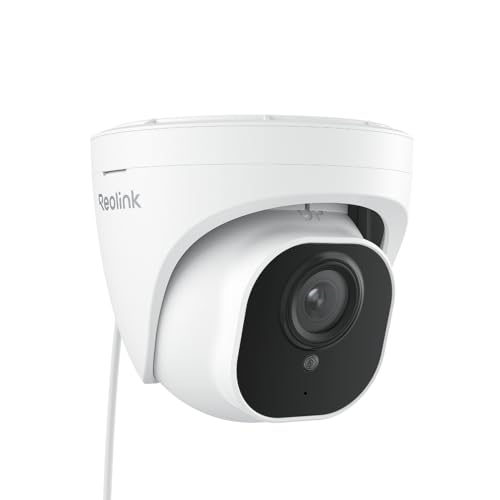
REOLINK RLC-820A 4K PoE Security Camera, Wired Outdoor Dome
$99.99The dome counterpart to the RLC-810A, same sensor and same detection, in a body that does not advertise which way it is looking.
- Resolution
- 8 MP
Prices change often.

Amcrest UltraHD 4K 8MP Outdoor Bullet Security IP PoE Camera, 98ft NightVision
$94.95Amcrest publishes its IR range and its lens focal length in the listing, which is rarer than it should be and is what makes a coverage calculation possible before you buy.
- Resolution
- 8 MP
- Stated IR range
- 98 ft
- Lens
- 2.8 mm
Prices change often.

Amcrest UltraHD 4K 8MP Outdoor Security IP Turret PoE Camera, 98ft NightVision
$88.99A turret aims like a bullet but sits in a dome housing, so it avoids the infrared bounce a true dome can get off its own cover glass.
- Resolution
- 8 MP
- Stated IR range
- 98 ft
Prices change often.
Amcrest 5MP Turret PoE Camera, UltraHD Outdoor IP Camera with Mic
$74.99Five megapixels and a built in microphone, and that microphone is the reason to read the audio recording section on this site before switching it on.
- Resolution
- 5 MP
Check first:This camera records audio. Audio is legally different from video and many US states require the consent of all parties. Check your own state before enabling it.
Check price on AmazonPrices change often.
Common questions
Do bullet and dome cameras from the same maker share the same sensor?
Often, yes. Reolink's RLC-810A bullet and RLC-820A dome, for example, both use an 8MP sensor with the same person and vehicle detection, and the only real difference the buyer sees is the body shape and how the camera is aimed. Checking the specs sheet rather than assuming from the body style is still worth doing before buying.
Is a dome camera really harder for someone to disable?
It is harder to redirect by hand, since there is no exposed barrel to twist, but a determined person can still damage or cover a dome. The realistic benefit is against casual tampering, such as someone nudging a camera out of frame in passing, rather than against a deliberate attack on the camera itself.
What is a turret camera exactly?
A turret is a bullet style lens and sensor mounted inside a small dome shaped housing rather than a cylindrical barrel. It aims the way a bullet does, with a visible front element, but sits lower and rounder, and it avoids the infrared reflection off a curved dome cover that can sometimes haze a true dome's night image.
Which body style is cheaper?
Bullets are usually the same price or slightly cheaper than the equivalent dome or turret from the same maker and sensor line, since the housing is simpler to manufacture. The difference is small enough that sensor resolution and detection features should decide the purchase before body style price does.
Can I mix bullet and dome cameras on the same recorder?
Yes. An NVR has no preference for body style, only for whether the camera is compatible with its brand or, on some recorders, with the ONVIF standard. Mixing bullets at reachable entry points with domes elsewhere on the same property, and the same recorder, is common and works without any special configuration.
Get the system planning sheet
The camera count, storage and PoE budget worksheet, plus the wiring checklist, as one printable page.
Keep going
Before you point a camera at anything. Aim cameras at your own property and your own boundary, never into a neighbour's windows or across their garden. Cameras in bedrooms, bathrooms, or anywhere else a person reasonably expects privacy are a serious legal problem, and that includes guests, lodgers and anyone who works in your home. Audio is legally different from video, many US states require the consent of every party to a recorded conversation, and several recorders capture audio by default, so check your own state before you enable it. Some places require visible notice that recording is taking place, and landlords and homeowner associations often impose their own rules on top. This is researched general information and not legal advice, and the law varies by state and by country.
And once it is installed. Change every default password, keep the firmware updated, and be clear with yourself about where the footage goes: a cloud camera means a third party holds recordings of your home, while a local recorder keeps them in your house. That is a genuine buying consideration, not a technicality.