PoE Standards and Power Classes
IEEE 802.3 defines PoE classes 0 through 8 across three standards, 802.3af, 802.3at (PoE+), and 802.3bt (PoE++). Each class sets two figures: what the switch port must reserve (PSE) and the smaller amount the camera is actually allowed to draw (PD). Class 3, at 15.4 W reserved, covers most fixed security cameras.
Power over Ethernet has three generations of standard, and each defines a set of power classes rather than one fixed wattage. A switch port announces or negotiates a class with the connected device, then reserves that class's power-sourcing-equipment (PSE) figure for the whole session, whether or not the camera uses all of it.
The gap between the PSE figure and the smaller powered-device (PD) figure in each class is not a rounding difference. It is the worst-case cable loss the standard assumes over a full-length run, which is why a switch power budget has to be summed on the PSE column and never on a camera's own stated draw.
| Class | Standard | Switch reserves (PSE) | Camera may draw (PD) | Assumed cable loss | Typical device |
|---|---|---|---|---|---|
| 0 | 802.3af | 15.4 W | 12.95 W | 2.45 W | Unclassified; switch must assume the full 15.4 W |
| 1 | 802.3af | 4.0 W | 3.84 W | 0.16 W | Very low power devices |
| 2 | 802.3af | 7.0 W | 6.49 W | 0.51 W | Small fixed cameras |
| 3 | 802.3af | 15.4 W | 12.95 W | 2.45 W | Most fixed PoE cameras, including IR bullets and domes |
| 4 | 802.3at | 30.0 W | 25.5 W | 4.5 W | PoE+: heaters, wipers, strong IR, small PTZ |
| 5 | 802.3bt | 45.0 W | 40.0 W | 5.0 W | PoE++ Type 3 |
| 6 | 802.3bt | 60.0 W | 51.0 W | 9.0 W | PoE++ Type 3, full-size PTZ with heater |
| 7 | 802.3bt | 75.0 W | 62.0 W | 13.0 W | PoE++ Type 4 |
| 8 | 802.3bt | 90.0 W | 71.3 W | 18.7 W | PoE++ Type 4, the ceiling of the standard |
| Setup | Total PSE load | Total PD draw | Recommended switch budget |
|---|---|---|---|
| 4 cameras, class 3 | 61.6 W | 51.8 W | 73.9 W |
| 8 cameras, class 3 | 123.2 W | 103.6 W | 147.8 W |
| 4 cameras, class 4 | 120.0 W | 102.0 W | 144.0 W |
| 6 cameras class 3 + 2 cameras class 4 | 152.4 W | 128.7 W | 182.9 W |
Why does a switch budget use the PSE figure and not the camera spec sheet?
A camera's own spec sheet lists its PD draw, the power it actually consumes once running. The switch, however, has no way to know in advance how much cable loss a given run will have, so the 802.3 standard requires it to reserve the larger, class-based PSE figure for every port at that class, regardless of the real run length.
Adding up PD figures across a multi-camera install will understate the switch capacity needed and can leave a switch that looks adequate on paper unable to actually power every port at once.
What changed between 802.3af, 802.3at, and 802.3bt?
802.3af (2003) defined classes 0 through 3, topping out at 15.4 W reserved. 802.3at (2009), marketed as PoE+, added class 4 at 30.0 W for devices like small PTZ cameras and heated housings. 802.3bt (2018), marketed as PoE++ or 4PPoE because it powers over all four cable pairs, added classes 5 through 8, reaching 90.0 W reserved at class 8.
- 802.3af: classes 0-3, up to 15.4 W reserved
- 802.3at (PoE+): adds class 4, up to 30.0 W reserved
- 802.3bt (PoE++): adds classes 5-8, up to 90.0 W reserved
The gear that matches this answer
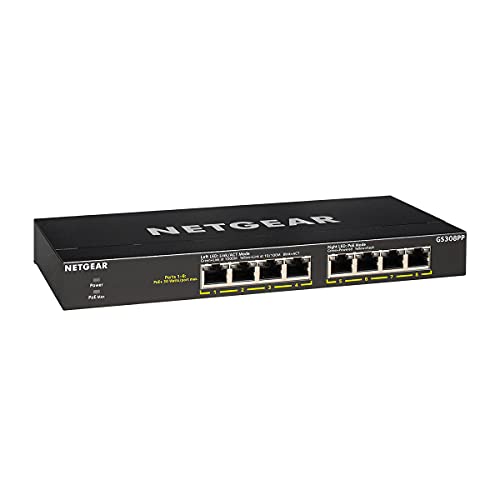
NETGEAR 8-Port PoE Gigabit Ethernet Unmanaged Network Switch GS308PP
$69.99An 83 W budget across eight PoE ports, which carries six to eight class 3 cameras with the headroom that stops a switch shutting a port down on a cold night when the heaters run.
- PoE ports
- 8
- PoE budget
- 83 W
- PoE standard
- 802.3af/at
Prices change often.

TP-Link 8 Port Gigabit PoE Switch, 8 PoE+ Ports at 126W
$89.99A 126 W budget is enough for eight class 3 cameras at their full standards allocation of 15.4 W each, with nothing left to chance.
- PoE ports
- 8
- PoE budget
- 126 W
- PoE standard
- 802.3af/at
Prices change often.

NETGEAR 16 Port PoE Gigabit Ethernet Unmanaged Network Switch GS316PP
$159.99The same sixteen ports with a 183 W budget, which is what a genuinely full sixteen camera system needs.
- PoE ports
- 16
- PoE budget
- 183 W
- PoE standard
- 802.3af/at
Prices change often.

TP-Link Omada PoE+ Injector, Up to 30W, Gigabit, POE160S
$19.99Thirty watts is the full 802.3at allocation, so this injector will run anything up to and including a small PTZ camera.
- PoE standard
- 802.3at
- PoE budget
- 30 W
Prices change often.

REOLINK RLC-810A PoE Security Camera, 4K Wired Outdoor
$84.99The default 4K PoE bullet in this catalog: person and vehicle detection on the camera itself, so alerts are not triggered by every passing shadow.
- Resolution
- 8 MP
- Lens
- 4 mm
- Storage
- PoE, needs an NVR or NAS
Prices change often.
Common questions
What PoE class does a typical fixed security camera need?
Most fixed bullet and dome cameras with standard infrared negotiate class 3, reserving 15.4 W on the switch port even though actual draw is closer to 5 to 10 W in normal operation. Cameras with strong IR arrays, built-in heaters for cold climates, or small pan-tilt-zoom mechanisms typically step up to class 4 (802.3at, PoE+) at 30.0 W reserved. Check the camera's own listed PoE class rather than assuming class 3.
Why do PoE++ switches list both 802.3at and 802.3bt support?
802.3bt is additive, not a replacement. A switch rated for 802.3bt classes 5 through 8 also negotiates the older 802.3af and 802.3at classes for devices that only support those, so one PoE++ switch port can power a class 3 camera at 15.4 W or a class 6 heated PTZ at 60.0 W depending on what is plugged in, without any configuration change.
Does a longer cable run reduce how much power a camera gets?
Yes, resistance in the copper pairs causes voltage drop that grows with run length, which is exactly the loss the gap between a class's PSE and PD figures is sized to cover at the standard's maximum distance. A run close to the ANSI/TIA-568 100 metre limit will see more loss than a short 20 metre run, which is why the standard's PD figure already assumes a worst-case run rather than a typical one.
What happens if a camera requests more power than its class allows?
The switch (the PSE) will not exceed the class it has negotiated with that specific port. A camera that tries to draw more than its class permits, for example a heater kicking on beyond a class 3 budget, will typically brown out, reboot, or fail to start the higher-draw feature rather than pull extra power the port is not budgeted to deliver.
Is an unclassified (class 0) device unsafe to use?
No, class 0 simply means the device did not report a specific class during negotiation, so the switch falls back to reserving the full 15.4 W of 802.3af to be safe, the same reservation as class 3. It is not a defect, but it does mean the switch cannot budget that port any tighter, which matters when trying to fit many ports onto a switch with a fixed total power supply.
Get the system planning sheet
The camera count, storage and PoE budget worksheet, plus the wiring checklist, as one printable page.
Keep going
Before you point a camera at anything. Aim cameras at your own property and your own boundary, never into a neighbour's windows or across their garden. Cameras in bedrooms, bathrooms, or anywhere else a person reasonably expects privacy are a serious legal problem, and that includes guests, lodgers and anyone who works in your home. Audio is legally different from video, many US states require the consent of every party to a recorded conversation, and several recorders capture audio by default, so check your own state before you enable it. Some places require visible notice that recording is taking place, and landlords and homeowner associations often impose their own rules on top. This is researched general information and not legal advice, and the law varies by state and by country.
And once it is installed. Change every default password, keep the firmware updated, and be clear with yourself about where the footage goes: a cloud camera means a third party holds recordings of your home, while a local recorder keeps them in your house. That is a genuine buying consideration, not a technicality.