Can you run PoE 50 feet over Cat5e?
A 50 foot Cat5e run is within the Ethernet limit. The standard allows a total channel of 100 metres, which is about 328 feet, made up of 90 metres of solid horizontal cable plus 10 metres of patch leads at both ends combined. This run leaves about 245 feet of margin.
How this is worked out
total channel = horizontal solid cable + patch leads at both ends, and must not exceed 100 m (about 328 ft)
The limit is not about power, it is about signal timing: Ethernet collision detection and the physical layer are specified against a maximum propagation delay. The 100 m limit is the whole channel: 90 m of solid horizontal cable plus 10 m of stranded patch leads at both ends combined.
| Run length | In metres | Plus patch allowance | Within spec | Margin |
|---|---|---|---|---|
| 50 ft | 15.2 m | 25.2 m | Yes | 245 ft |
| 100 ft | 30.5 m | 40.5 m | Yes | 195 ft |
| 150 ft | 45.7 m | 55.7 m | Yes | 145 ft |
| 200 ft | 61 m | 71 m | Yes | 95 ft |
| 250 ft | 76.2 m | 86.2 m | Yes | 45 ft |
| 300 ft | 91.4 m | 101.4 m | No | -5 ft |
| 328 ft | 100 m | 110 m | No | -33 ft |
| 400 ft | 121.9 m | 131.9 m | No | -105 ft |
| 500 ft | 152.4 m | 162.4 m | No | -205 ft |
| Approach | How it works | When it is the right answer |
|---|---|---|
| PoE extender | Repeats power and data, adding another 100 m segment. | A single long run to a gate or outbuilding. |
| Switch partway | A small PoE switch at the midpoint restarts the length budget. | Several cameras clustered at the far end. |
| Fibre with a media converter | Optical link with no distance limit of practical concern. | Runs of several hundred metres, or where lightning risk between buildings matters. |
| Wireless bridge | A point to point radio link carries the data, power comes from the far end. | Where no cable route exists at all. |
| Move the camera | Re-site so the run fits. | Very often the cheapest and most reliable answer. |
Why Cat5e for this run
Fully rated for gigabit and for PoE. Not the bottleneck for any security camera. For a security camera the data rate is never the deciding factor: a 4K camera at 6 Mbps uses well under one percent of a gigabit link, so Cat5e and Cat6 are equally capable of carrying the video.
Where the cable specification genuinely matters is power. Thicker conductors have less resistance, so less of the switch's voltage is lost on the way to the camera. On runs approaching the limit, 23AWG solid copper Cat6 delivers noticeably more power to the camera than 24AWG Cat5e.
The conductor material matters more than the category
Buy solid bare copper. Copper clad aluminium, sold as CCA, is cheaper and appears constantly in bulk cable listings, and it is a genuinely poor choice for PoE. Aluminium has roughly 60 percent of the conductivity of copper, so voltage drop over a long powered run is far worse, and CCA sits outside the wiring standards for powered runs.
It is also solid core rather than stranded for anything in a wall. Solid conductors terminate into punch down keystone jacks and have lower resistance. Stranded patch cable is for the short flexible leads at each end and should not be used for the run itself.
Cable and tools for this run
Solid bare copper only. Copper clad aluminium is cheaper and is the wrong cable for a powered run.

AiCat Cat5e Ethernet Cable 500ft Riser CMR, Solid Bare Copper
$98.99Cat5e is fully rated for gigabit and for PoE, and for a 4K camera at 8 Mbps it is not remotely the bottleneck, so this is where to save money rather than on the conductor material.
- Cable category
- Cat5e
- Conductor
- Solid bare copper
- Length
- 500 ft
Prices change often.
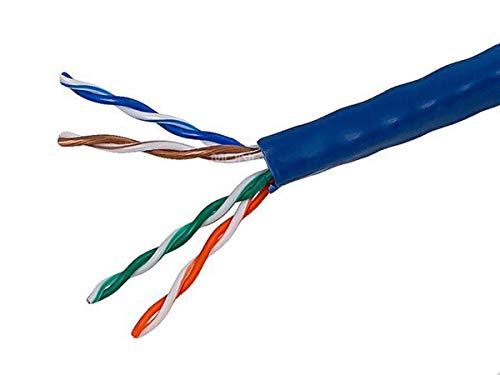
Monoprice Cat5e Ethernet Bulk Cable, Solid, 350MHz, UTP, CMR
$79.82The cheapest solid conductor bulk cable here from a seller that publishes its specifications honestly.
- Cable category
- Cat5e
- Conductor
- Solid
- Length
- 500 ft
Prices change often.

TRUE CABLE Cat6 Direct Burial Bulk Ethernet Cable, Unshielded, 1000ft, 23AWG Solid Bare Copper
$277.99Direct burial rated with a solid bare copper conductor at 23AWG, which is the thickest common gauge and therefore the least voltage drop over a long PoE run.
- Cable category
- Cat6
- Conductor gauge
- 23 AWG
- Conductor
- Solid bare copper
- Length
- 1000 ft
Prices change often.

Klein Tools VDV526-100 Network LAN Cable Tester with Remote
$21.00The cheapest tester worth owning, and it catches the split pair and reversed pair faults that make a camera connect at 100 Mbps and then drop under load.
Check price on AmazonPrices change often.
Common questions
How far can you run PoE over Cat5e?
The standard allows 100 metres, about 328 feet, for the whole channel including the patch leads at each end. That means roughly 295 feet of cable in the wall. Beyond that, a PoE extender adds another full segment, and the limit is set by Ethernet signal timing rather than by how far the power can travel.
Will a 50 foot run work for a security camera?
Yes. At 50 feet you are inside the 328 foot channel limit with about 245 feet of margin for the patch leads at both ends. Use solid bare copper cable and terminate into keystone jacks rather than crimped plugs, and the run will be reliable.
What happens if I exceed the 100 metre limit?
It rarely fails cleanly, which is what makes it hard to diagnose. A run slightly over the limit often works at first, then drops intermittently, negotiates at 100 Mbps instead of gigabit, or fails once the temperature changes. Intermittent camera dropouts on one channel are very often an over-length or badly terminated run rather than a faulty camera.
Does PoE power reach less far than data?
Both are specified to the same 100 metre channel, and the standard already accounts for worst case power loss over that full distance. That is why a switch reserves 15.4 W per class 3 port to deliver 12.95 W at the camera. Power and data are designed to reach the same distance, so one limit covers both.
Get the system planning sheet
The camera count, storage and PoE budget worksheet, plus the wiring checklist, as one printable page.
Keep going
Before you point a camera at anything. Aim cameras at your own property and your own boundary, never into a neighbour's windows or across their garden. Cameras in bedrooms, bathrooms, or anywhere else a person reasonably expects privacy are a serious legal problem, and that includes guests, lodgers and anyone who works in your home. Audio is legally different from video, many US states require the consent of every party to a recorded conversation, and several recorders capture audio by default, so check your own state before you enable it. Some places require visible notice that recording is taking place, and landlords and homeowner associations often impose their own rules on top. This is researched general information and not legal advice, and the law varies by state and by country.
And once it is installed. Change every default password, keep the firmware updated, and be clear with yourself about where the footage goes: a cloud camera means a third party holds recordings of your home, while a local recorder keeps them in your house. That is a genuine buying consideration, not a technicality.